



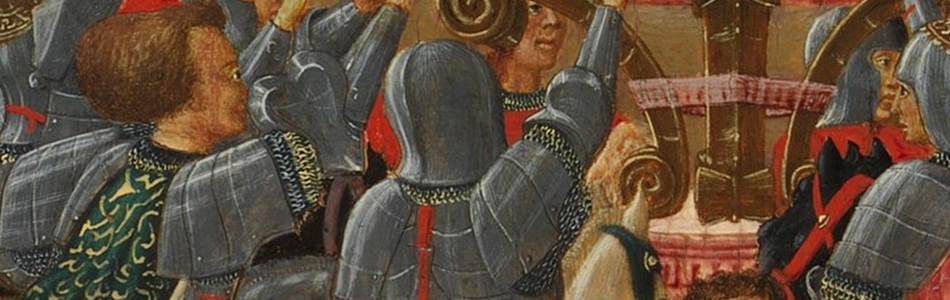
With the acquisition of the first complete set of armour in the early 2000s, we questioned what Italian men-at-arms wore under their armour in the 15th century and how it was fashioned.
In our Reenactments, armour was typically worn over a gambeson, a padded tunic of varying lengths, to which armour pieces were attached using leather laces passing through specific eyelets.
This solution seemed unrealistic to us. Therefore, we decided to delve deeper into the subject by studying both written and iconographic documents. Based on this research, we hypothesized that, at least from the second quarter of the 15th century, a doublet was worn under the armour.
The doublet is a garment that originally emerged for military use. Widely adopted in this context since the late 14th century, it evolved in the 15th century, changing in form and volume. It fit tightly to the body to emphasize the torso and extended slightly below the waist, modified to adhere to the aesthetic standards imposed by the burgeoning fashion of the 15th century.
This garment was used throughout Italy and is named after the padding worn to protect the chest. Initially conceived as additional protection, the padding later became purely aesthetic, compensating for any muscular deficiencies and shaping the body to the beauty ideals of the time.
In Florentine dialect, this padding was called "farsa," hence the term "farsetto" (doublet). In other Italian regions, such as Venice, the doublet was known as “zuppa,” "zupone," or "zuparello," terms derived from the Venetian dialect "inzupare," meaning to stuff or fill. In other parts of the Italian peninsula, the garment was often referred to as "giubba" or "giubbone," stemming from variations of "zuppa" and "zupone." These terms frequently appear in military-related documents from the period.
After moving beyond initial "do-it-yourself" experiments useful for "field tests," we collaborated with Paola Fabbri and began studying the creation of an “arming doublet.”
Among the most famous doublets is undoubtedly the funerary doublet of Pandolfo III Malatesta, dating back to a period before 1427, the year the Rimini nobleman and military leader died.
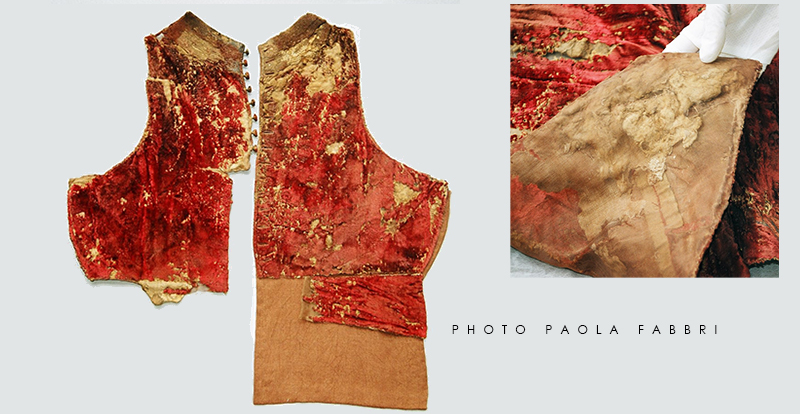
Photo Paola Fabbri - Pandolfo III Malatesta doublet - front part and detail of the "farsa"
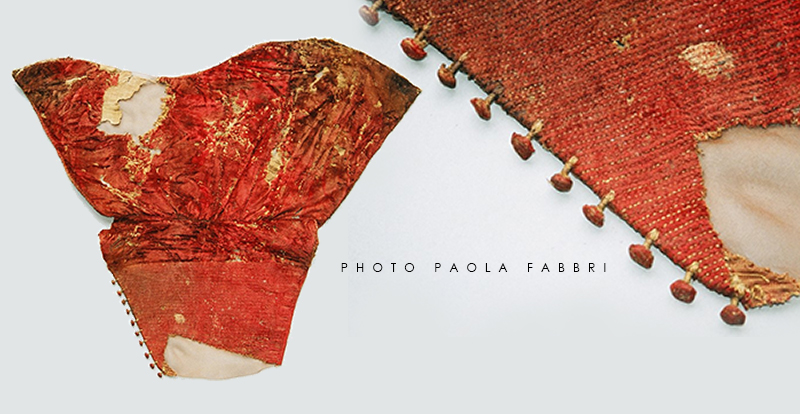
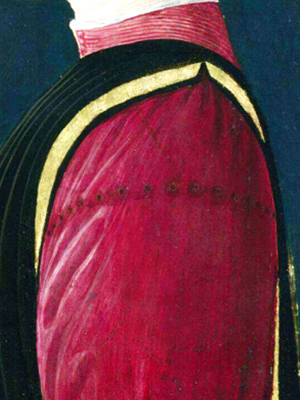
foto Paola Fabbri - Pandolfo III Malatesta doublet - sleeve and detail of the topstitching
Iconographic analysis of 15th-century portraits proved extremely valuable for understanding the fashion and tailoring techniques of the period. In numerous paintings and frescoes of the time, male subjects are depicted wearing civilian doublets with characteristics typical of "arming doublets." These detailed representations not only provide important insights into the fashion of the era but also highlight the close connection between civilian and military use of this garment.
Through careful comparison of the material artifact and various iconographic sources, we identified the distinguishing features of this type of doublet. This comparative analysis allowed us to more precisely outline the specific functions and characteristics of the doublet.


Manuscript MS 55, fol 122b-123b. 1460. Pierpont Morgan Library, New York
Manuscript MSS Ott.lat.1417 Biblioteca Apostolica Vaticana - Giovanni di Ser Nicolò de’ Castaldi di Fano – 1460
Documentary sources were crucial in identifying suitable materials to create this garment. The doublet of Fano was made with long-pile crimson silk velvet, a fabric accessible to the wealthy lord of Fano but less so for minor commanders or men-at-arms. Registers and letters indicating orders for its production helped identify the fabrics used.
The most commonly used fabrics included "panno" (wool cloth), velvet, and "panno lino" (linen cloth). After experimenting with wool cloth, we mainly chose to use linen cloth due to its greater resistance to the wear and tear caused by armour use. The linen used for our doublets primarily came from late 19th or early 20th-century weaving, originally intended for personal or household linen. Initially, these materials were easily available at low prices. Nowadays, however, it is necessary to carefully evaluate market offerings due to significant price increases.
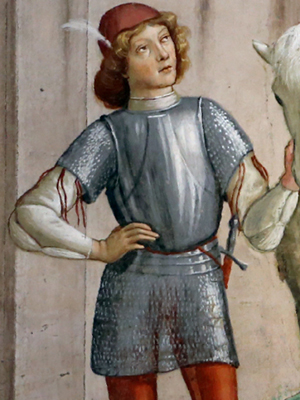

Frescoes of the Stories of Saint Martin, workshop of Domenico Ghirlandaio. 1475/1480. Oratory of the Buonomini di San Martino - Florence
Photo Archive Famaleonis
The "arming doublet" differs from the civilian doublet in specific details that make it suitable for military use.
These details were designed to create a sturdy and functional garment for attaching armour plates. Unlike the civilian doublet, the military doublet had strategically placed eyelets for securing different armour parts.
Shoulder eyelets allowed for attaching arm protectors, while those at the waist secured leg armour and other essential components like chainmail skirts covering the groin.
In another article, we will discuss the chainmail worn under the armour, another important distinguishing element of the men-at-arms.
Our research and experiments have shown that when the doublet is carefully and precisely made, directly attaching leg protectors to it is more comfortable and durable, providing greater stability and adherence, enhancing the mobility of the men-at-arms.

Panel Painting, Portrait of Leonello d'Este, Giovanni da Oriolo, circa 1447. National Gallery, London
Photo Archive Famaleonis
The eyelets on the arming doublet, like those on the civilian doublet, were reinforced with metal rings, often made of copper alloy or a brass-like mixture. The various armour pieces were attached using fabric or leather laces with metal tips, known as "aglets," facilitating passage through the eyelets. In the civilian realm, especially in noble courts, shoulder eyelets were common, often adorned with rich and elaborate silk laces to highlight warrior pride and social status of the wearer.
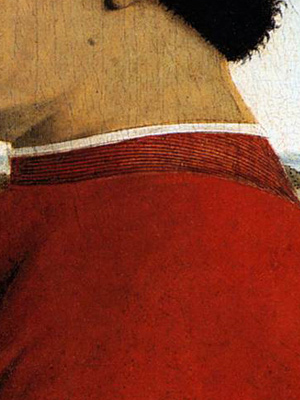
Panel Painting, The Dukes of Urbino Federico da Montefeltro and Battista Sforza, Piero della Francesca, 1473-75. Uffizi Galleries, Florence
Photo Archive Famaleonis
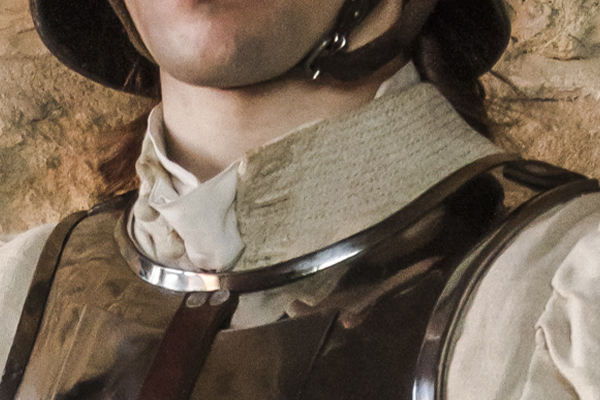
To fully understand the complexity and functionality of the arming doublet, it is essential to consider the role of quilting. Stitches, spaced apart, traversed the different fabric layers, contributing to the overall rigidity of the garment. Quilting was strategically placed in areas most exposed to wear and tear, like the forearms, which constantly rubbed against the arm protectors. The flaps and collar also underwent significant mechanical stress from friction with riveted chainmail, and quilting in these critical areas not only improved the durability of the doublet but also enhanced its protective effectiveness.
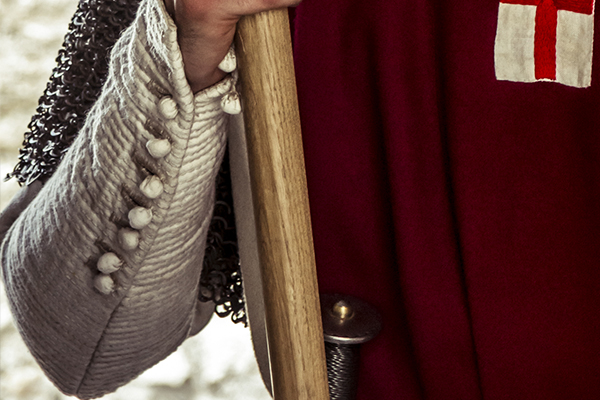
Photo Archive Famaleonis
In models made by Paola Fabbri, the quilting stiffened the doublet to the point of resembling a motorcycle jacket with protective gear. This stiffness initially caused minor bruises on the inner forearm near the elbow due to the material's resistance.


Cassone Painting, Expulsion of Tarquin from Rome, Master of Marradi, circa 1480. Private Collection
Photo Archive Famaleonis
After extensive testing with different types of armour and protections, and years of practical use, we can state that our studies confirm the likely reality of the medieval period.
The significant discovery of the funerary garments of Diego Cavaniglia, a nobleman and military leader from southern Italy who died around 1480, brought to light a new artifact of great relevance. Through continuous collaboration with Paola Fabbri, who had direct access to the original artifact, we confirmed our hypotheses regarding the cut and details of the arming doublets made for Famaleonis members.
Paola Fabbri created a replica of Cavaniglia's doublet as part of her study. We will delve deeper into this topic in the future when we have more interesting updates to share with you.